AppSec Code review critical
CVE-2026-24895: Path Confusion RCE in FrankenPHP via Unicode Case Folding
FrankenPHP lowercases the request path to detect the ".php" extension, but Go's Unicode case folding can grow a string's byte length. The resulting offset error lets an uploaded text file execute as PHP.
- Target
- FrankenPHP
- Language
- Go
A one-byte accounting error between an uppercase character and its lowercase form is enough to turn a harmless file upload into remote code execution. This write-up walks through how PHP decides which file to run, where FrankenPHP’s extension check goes wrong, and why the character Ⱥ is the key to the exploit.
Background: How the Server Tells PHP What to Run
Section titled “Background: How the Server Tells PHP What to Run”PHP doesn’t handle HTTP requests on its own. A web server (Apache, Nginx, or FrankenPHP) receives the request first, works out which script should run, and passes the request details along to PHP. That hand-off follows the CGI (Common Gateway Interface) standard, where the server hands PHP a set of environment variables.
For a request to https://host/uploads/script.php/some/extra/path?cmd=whoami, the variables that matter most are:
| Variable | Purpose | Example |
|---|---|---|
SCRIPT_FILENAME | Absolute path of the PHP file to execute | /app/public/uploads/script.php |
SCRIPT_NAME | URL path identifying the script | /uploads/script.php |
PATH_INFO | Extra path after the script name | /some/extra/path |
QUERY_STRING | The ?key=value portion | cmd=whoami |
DOCUMENT_ROOT | Root directory of the application | /app/public |
The critical one is SCRIPT_FILENAME. When PHP receives a request, it reads SCRIPT_FILENAME to decide which file on disk to load and execute, and it trusts the web server to have set that value correctly. PHP doesn’t second-guess whether the target “should” be a PHP file. If SCRIPT_FILENAME points at /app/public/uploads/evil.txt and that file contains <?php ... ?>, PHP will happily execute it.
So the security of the whole arrangement rests on the server computing the script path correctly. That is exactly where this bug lives.
The Flaw: A Case-Insensitive Extension Check
Section titled “The Flaw: A Case-Insensitive Extension Check”To support .PHP, .Php, .pHp and every other capitalization, FrankenPHP lowercases the path before looking for the .php extension. In spirit, the logic is:
// Illustrative of the pattern, not verbatim FrankenPHP source.lowered := strings.ToLower(path)idx := strings.Index(lowered, ".php")// ... then use idx to split the script path from PATH_INFO,// slicing the ORIGINAL path at an index computed on the lowered one.scriptName := path[:idx+len(".php")]pathInfo := path[idx+len(".php"):]For pure ASCII, this is fine: lowercasing an ASCII letter never changes its byte length (P → p is one byte either way), so an index found in the lowered string lines up perfectly with the original.
The bug is a side effect of being thorough. strings.ToLower() performs full Unicode case folding, not just ASCII. For some characters, the lowercase form needs more bytes in UTF-8 than the uppercase form. When that happens, an index measured on the lowered string no longer points at the same position in the original string.
Why Ⱥ Is the Key
Section titled “Why Ⱥ Is the Key”A handful of Unicode characters expand by one byte when lowercased. Two of them:
| Character | Codepoint | UTF-8 bytes | Lowercase | Codepoint | UTF-8 bytes | Change |
|---|---|---|---|---|---|---|
Ⱥ | U+023A | C8 BA (2) | ⱥ | U+2C65 | E2 B1 A5 (3) | +1 byte |
Ⱦ | U+023E | C8 BE (2) | ⱦ | U+2C66 | E2 B1 A6 (3) | +1 byte |
Each Ⱥ in the path adds one byte of offset error. Line up four of them and the index drifts by four bytes, which is exactly enough to move the detected .php boundary off the real one.
Consider the path /ⱭⱭⱭⱭshell.php.txt. Here is the original request path, 22 bytes:
Offset Bytes Char0 2F /1-2 C8 BA Ⱥ3-4 C8 BA Ⱥ5-6 C8 BA Ⱥ7-8 C8 BA Ⱥ9 73 s10 68 h11 65 e12 6C l13 6C l14 2E . <- ".php" begins here (byte 14)15 70 p16 68 h17 70 p18 2E .19 74 t20 78 x21 74 tAfter strings.ToLower(), each Ⱥ (2 bytes) becomes ⱥ (3 bytes), pushing everything after the four characters 4 bytes to the right. The string is now 26 bytes:
Offset Bytes Char0 2F /1-3 E2 B1 A5 ⱥ4-6 E2 B1 A5 ⱥ7-9 E2 B1 A5 ⱥ10-12 E2 B1 A5 ⱥ13 73 s14 68 h15 65 e16 6C l17 6C l18 2E . <- ".php" now begins at byte 18 (shifted +4)19 70 p20 68 h21 70 p22 2E .23 74 t24 78 x25 74 tThe code finds .php at byte 18 in the lowered string, then uses 18 to slice the original path, where .php actually starts at byte 14. The split lands in the wrong place, and the .txt file ends up being handed to PHP as a script to execute.
Exploitation
Section titled “Exploitation”The attack chain is short once an upload is allowed:
- Upload a file whose name contains the expanding characters, for example
ⱭⱭⱭⱭshell.php.txt, with a PHP payload inside it. A classic choice is a minimal web shell such as p0wny-shell. - Request that file. FrankenPHP’s offset miscalculation causes the server to set
SCRIPT_FILENAMEto the uploaded file and treat it as PHP. - PHP executes the payload, and the
.txtfile runs as code.
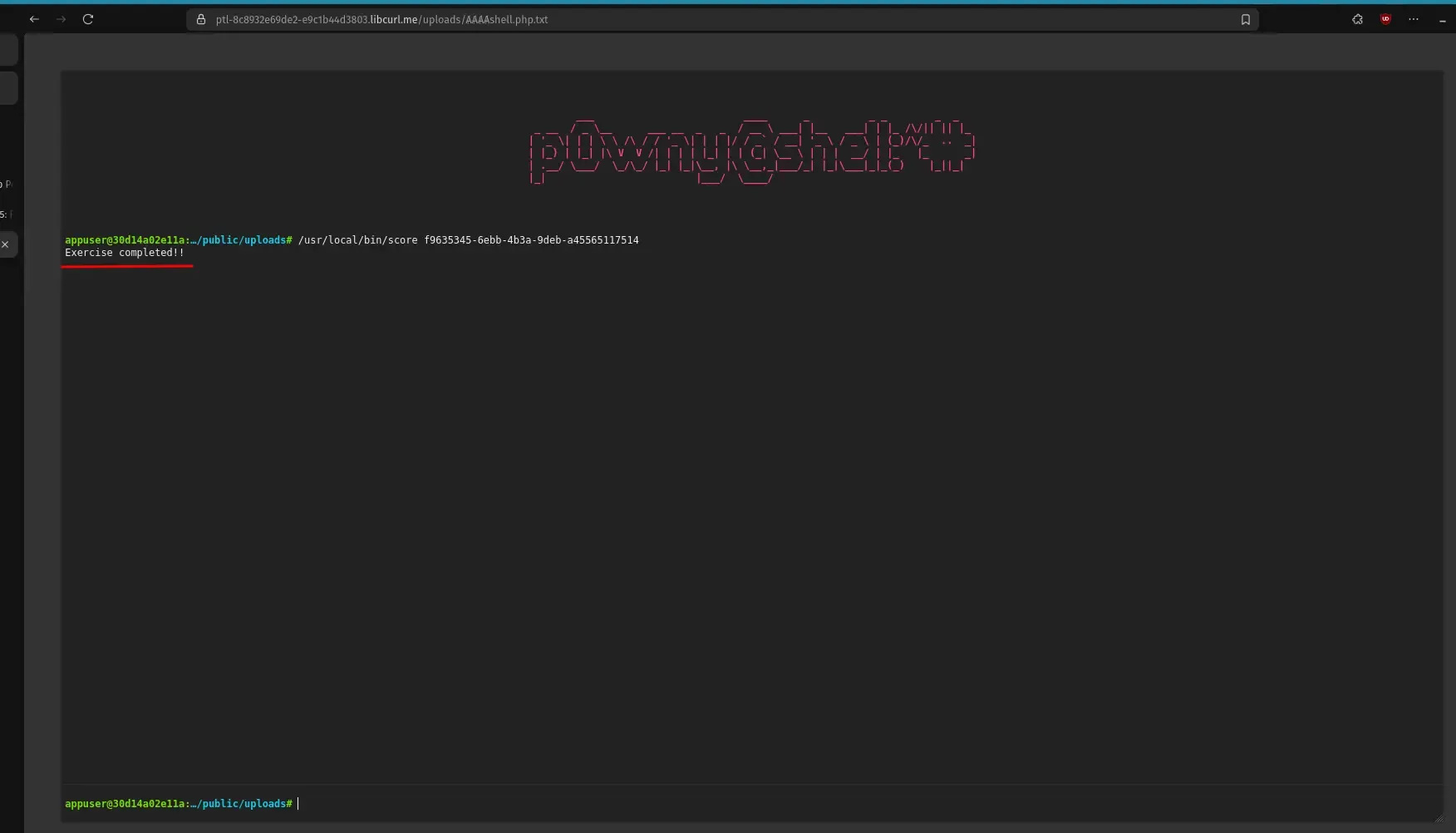
On the PentesterLab exercise, this lands a working web shell:
The Fix
Section titled “The Fix”The root cause is comparing lengths and positions across two strings that no longer share a byte layout. The safe approaches all avoid that mismatch:
- Don’t change the byte length during the check. Detect the extension in a way that operates on the original bytes, for example by lowercasing only ASCII letters so no multi-byte expansion can occur.
- Compute and slice on the same string. If the path is normalized, derive the split point from the normalized form and keep using that form, never mixing an index from one string with the bytes of another.
- Reject ambiguous paths. A request path for a script that contains non-ASCII characters in the extension region is suspicious on its own and can be refused.
More broadly, this is a reminder that SCRIPT_FILENAME is a security boundary. Anything that can steer it (path parsing, rewrites, uploads landing in a web-served directory) deserves the same scrutiny as an authentication check.
Takeaways
Section titled “Takeaways”- Case-insensitive matching on untrusted input is risky in any language with full Unicode case folding. An index found on a folded string is not safe to apply to the original.
- Path confusion keeps turning file uploads into code execution. Store uploads outside the web root, or serve them in a way that can never invoke an interpreter.
- When you review parsing code, watch for a length or index computed on one representation of a string and then used against another. That mismatch is where these bugs hide.